


America’s Debt Surge Is Accelerating
As federal borrowing accelerates and interest costs surge past historic levels, investors are turning to gold.
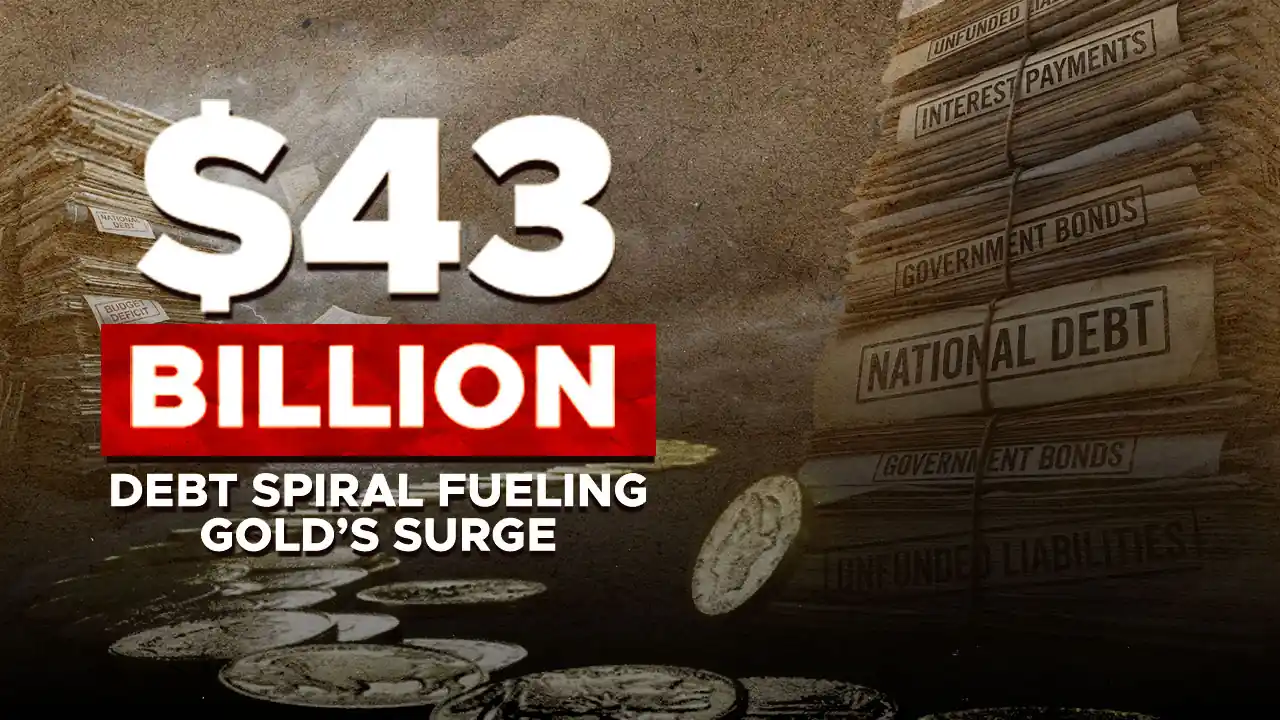
Gold is hovering near $5,000 per ounce after climbing almost 50% in just six months. At the same time, Washington is borrowing more than $43 billion every single week. Those two trends are not unrelated.
The first four months of fiscal year 2026 have delivered a stark reminder of how quickly the country’s fiscal imbalance is expanding. According to the Congressional Budget Office, the federal government borrowed $696 billion between October and January. January alone accounted for $94 billion.
Total national debt now exceeds $38.5 trillion. For perspective, U.S. GDP stands at about $31 trillion, according to the Federal Reserve Bank of St. Louis. In other words, the country’s debt load now rivals the size of the entire economy.
The cost of carrying that debt is becoming one of the fastest-growing line items in the federal budget. Treasury data shows that $427 billion in interest has already been paid this fiscal year through January 31. If that pace continues, annual interest payments could again reach or exceed $1 trillion. That milestone was first crossed in FY2024, when interest totaled $1.13 trillion. In FY2025, it rose to $1.22 trillion.
Maya MacGuineas, president of the Committee for a Responsible Federal Budget, warned: “We are only a third into FY 2026, and yet we remain in the routine of endless borrowing…If we continue to borrow at this rate, it leaves us on the path to another year of a $1.8 trillion or higher deficit.” She added, “Unless lawmakers want record-high debts and deficits to be our norm, both sides of the aisle must come together to address our unsustainable borrowing. The longer lawmakers wait, the higher the price for Americans.”
Many economists argue that the U.S. retains tools to manage a debt crisis if necessary. Policies sometimes described as “financial repression” could require institutions to hold more government debt. Higher inflation could reduce the real value of outstanding obligations. Quantitative easing could expand the money supply and lower borrowing costs. None of these solutions come without tradeoffs, particularly for consumers.
For long-term investors, this environment helps explain gold’s recent strength. When debt expands faster than economic output and interest costs consume larger portions of revenue, confidence in paper assets can weaken. Historically, tangible assets have benefited in those periods.
Long-term projections are even more sobering. The CBO estimates that deficits will remain elevated for the next decade. The shortfall is projected at $1.8 trillion in 2026, or 5.8% of GDP. By 2036, it could reach $3.1 trillion, roughly 7% of the economy. Annual interest costs are projected to climb to $2.14 trillion by 2036.
Much of the growth in spending will be driven by mandatory programs. Social Security outlays are projected to increase from $1.6 trillion in 2026 to $2.7 trillion by 2036. Major health care programs such as Medicare and Medicaid are expected to rise from $1.9 trillion to $3.1 trillion over the same period. An aging population is a central driver of these trends.
Ray Dalio, founder of Bridgewater Associates, has compared rising debt service to “plaque in the arteries.” Speaking on Fox Business, he said, “We’re spending 40% more than we’re taking in, and this is a chronic problem…What you’re seeing is the debt service payments…well into squeezing away, so it’s like plaque in the arteries, squeezing away buying power.”
Whether through economic growth or structural reform, the math will eventually have to balance. Until then, rising debt, rising interest costs, and growing fiscal pressure remain defining features of America’s outlook—and one reason tangible assets continue to draw attention.

Reagan Gold Group: Precious Metals Guidance You Can Understand
Reagan Gold Group provides education and personalized guidance for individuals exploring physical gold and silver. Our team helps clients understand direct ownership and Precious Metals IRA options while considering how tangible assets may fit into a broader diversification strategy.
If current economic or market developments have you reviewing your approach, speak with a Reagan Gold Group specialist to learn more about physical precious metals and the factors to consider before making a decision.