




Gold Surges as Middle East Conflict Drives Safe-Haven Demand
Escalating geopolitical tensions and rising global uncertainty push investors toward physical gold
Gold is once again proving why it has served as the ultimate financial safe haven for thousands of years. The price of gold surged nearly 3% to top $5,400 an ounce on March 2, marking its highest level in over a month as escalating war in the Middle East rattled global markets and sent investors rushing toward safety.
The advance follows another gain of more than 3% last week and pushes gold’s 2026 performance to roughly 25% year to date, reflecting steady demand in an environment where geopolitical tension, fiscal strain and global uncertainty continue to build.
The immediate catalyst was a series of coordinated strikes by the United States and Israel against Iran over the weekend. Iran responded with missile attacks targeting Israeli positions and U.S. military sites across the Gulf region. The developments increased fears that the conflict could broaden, and financial markets reacted accordingly.
Global equities sold off. Investors reassessed risk exposure. Government bonds weakened as markets evaluated the financial cost of rising military involvement and expanded spending commitments. When large-scale geopolitical events unfold quickly, confidence in traditional paper assets often fades. Capital does not disappear in those moments. It relocates.
This time, it relocated into physical gold.
Silver also moved higher, up roughly 14% in February. Precious metals have historically performed well during periods of war, currency pressure and inflation risk. Unlike stocks or bonds, it does not represent a claim on future performance or political stability. It exists as a finished asset. It does not depend on earnings guidance or central bank messaging.
Gold’s recent move is part of a broader trend rather than a one-day reaction. Earlier this year, prices pulled back from a late January record above $5,595 an ounce. Yet buyers returned quickly, signaling that underlying demand remains strong even after corrections. That resilience is often overlooked during quieter periods.
Central banks continue to accumulate gold as part of reserve diversification strategies. Governments worldwide are operating with elevated debt levels. Persistent deficits and long-term fiscal pressure have fueled ongoing concerns about currency stability. Investors who pay attention to these structural issues understand that gold’s appeal does not rely on daily headlines.
“Gold is set to benefit from geopolitical instability, less risk appetite and inflation concerns amid skyrocketing energy costs,” analysts at TD Securities wrote in a Sunday note. Investors, who may have been pulling back from the long gold trade in recent weeks, “could see the developments in the Middle East as an opportunity to get back in,” TD said.
Beyond the current conflict, broader uncertainty remains embedded in the global landscape. Trade disputes, shifting alliances and rising defense commitments have altered the tone of international relations. The United States now maintains its largest Middle East military presence since the Iraq War. Whether tensions escalate further or stabilize, the underlying risk premium has not disappeared.
Physical gold occupies a unique position in this environment. It does not require digital infrastructure. It is not exposed to counterparty failure. It cannot be expanded by policy decree. For investors concerned about preserving purchasing power across cycles, that distinction matters.
Markets may fluctuate, but the logic behind gold ownership remains consistent. During periods when volatility rises and confidence in financial systems weakens, tangible assets tend to attract attention. Gold has done so repeatedly across modern history.
For those seeking stability in an increasingly unpredictable world, physical gold continues to stand apart as a disciplined store of value. Its recent surge reflects more than reactionary trading. It underscores gold’s long-standing role as real, hard money during periods when financial confidence is tested.
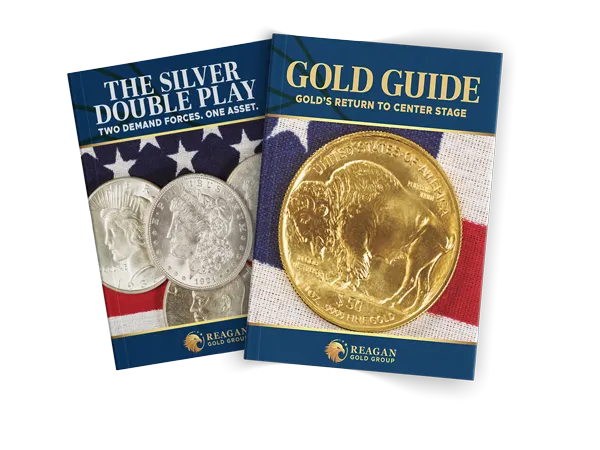
Reagan Gold Group: Precious Metals Guidance You Can Understand
Reagan Gold Group provides education and personalized guidance for individuals exploring physical gold and silver. Our team helps clients understand direct ownership and Precious Metals IRA options while considering how tangible assets may fit into a broader diversification strategy.
If current economic or market developments have you reviewing your approach, speak with a Reagan Gold Group specialist to learn more about physical precious metals and the factors to consider before making a decision.