



The Market Correction Is Maturing as Bigger Risks Start to Emerge
Rising debt, geopolitical risk, and policy uncertainty are building a stronger case for gold
Morgan Stanley’s Mike Wilson has spent years warning that the economy was weaker beneath the surface than headline data suggested. While markets pushed higher, he argued a “rolling recession” was quietly moving from sector to sector. Now, his latest call reframes today’s volatility in a way most investors are not expecting.
According to Wilson, this is not the start of a new bear market. It is the late stage of a correction that has already done significant damage under the surface.
Roughly half of all stocks in the Russell 3000 are down at least 20% from their highs. Even within the S&P 500, more than 40% of companies have fallen to that level. The index itself may only be down around 15%, but that number masks how widespread the decline has been.
This matters because it suggests the pain investors fear may already be behind them, not ahead.
Wilson points to improving fundamentals to support that view. Earnings growth remains strong at roughly 13% and is accelerating. Fiscal support is still flowing through the system, and the Federal Reserve has shifted back toward a more accommodative stance. Even the recent spike in oil, while significant, has not yet reached the levels that historically derail economic cycles.
In that context, the recent sell-off tied to the Iran conflict may represent a capitulation event rather than the beginning of a deeper downturn.
But there is a catch.
Wilson’s outlook depends heavily on the assumption that the conflict remains contained and oil prices stay below $100. If that changes, the entire framework shifts. A prolonged disruption, especially through the Strait of Hormuz, could quickly turn a “correction within a bull market” into something far more serious.
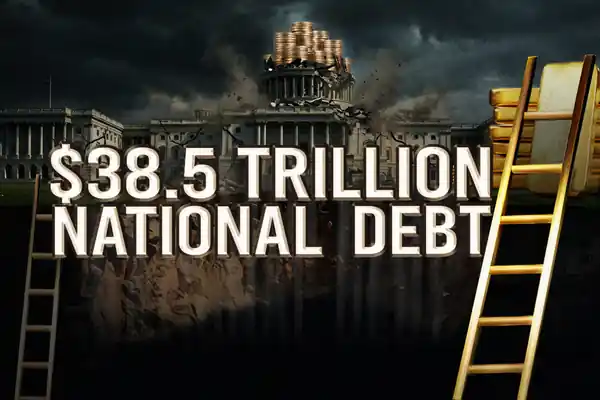
That uncertainty sits on top of a much larger structural issue. The United States now carries more than $38 trillion in national debt. Interest payments alone exceed defense spending. Major entitlement programs face solvency challenges within the next decade. While markets and economic data still appear stable, history shows that fiscal deterioration often unfolds slowly, then all at once.
For investors, this creates a clear tension. On one hand, equities may be stabilizing after an extended correction. On the other, the broader system remains increasingly fragile, exposed to geopolitical shocks, rising debt burdens, and policy uncertainty.
This is exactly where gold re-enters the conversation.
Despite a muted reaction to the Iran conflict so far, the underlying drivers for gold remain firmly intact. UBS analysts continue to project prices rising toward $5,900 to $6,200 per ounce, supported by central bank demand, persistent deficits, and a shifting interest rate environment.
Short-term movements can be misleading. In many past conflicts, gold initially surged, then pulled back as investors sought liquidity and central banks adjusted policy. What matters is not the immediate reaction, but the broader macro backdrop.
Gold is not simply a war trade. It is a hedge against the consequences of war.
Rising energy prices can feed inflation. Expanding deficits can pressure currencies. Slowing growth can force policy responses that weaken real yields. These are the conditions where gold has historically performed best.
Demand trends reinforce that outlook. Central banks continue to accumulate gold as they diversify away from the dollar. Investment demand remains steady. Structural constraints on supply add another layer of support.
Put simply, the same forces that define today’s uncertainty are the ones that strengthen gold’s long-term case.
Wilson may be right that the stock market is closer to the end of its correction than the beginning. But that does not eliminate risk. It simply changes where that risk sits.
Investors are no longer just navigating market cycles. They are navigating a system under pressure.

Reagan Gold Group: Precious Metals Guidance You Can Understand
Reagan Gold Group provides education and personalized guidance for individuals exploring physical gold and silver. Our team helps clients understand direct ownership and Precious Metals IRA options while considering how tangible assets may fit into a broader diversification strategy.
If current economic or market developments have you reviewing your approach, speak with a Reagan Gold Group specialist to learn more about physical precious metals and the factors to consider before making a decision.